
December 12, 2025
Understanding the Google Core Update of December 2025: What It Means, Who It Affects, and How to Respond
December 10, 2025
Answer Engine Optimization (AEO): Complete Guide to Dominate AI-Powered Search in 2026
December 9, 2025

Author:
.png)
Introduction: What Is Generative Engine Optimization (GEO)?
Generative Engine Optimization (GEO) is a new discipline within search optimization focused on helping content get selected, quoted, or used by AI search engines—not traditional SERPs.
This includes:
Traditional SEO optimizes for ranking positions.
GEO optimizes for being chosen as a source for the AI-generated answer.
If SEO is about visibility, GEO is about inclusion — being included inside the model’s reasoning and output.
Because AI engines increasingly generate answers rather than list them, GEO is becoming one of the most important evolutions in search since the introduction of mobile-first indexing.
Why GEO Matters in 2025
The search landscape has fundamentally shifted.
AI engines:
This means:
For some industries (education, finance, tech, health), AI search is already generating 10–40% of discoverability.
GEO is no longer optional.
It is the new foundation of organic acquisition.
How Generative Engines Actually Choose What to Cite
Generative models like GPT-4, Claude, and Gemini prioritize:
Optimizing content for generative engines is essential for improving visibility in AI-driven search results, as it ensures your information is discoverable and relevant to users interacting with AI-powered platforms. Enhancing your content's visibility to generative AI engines is crucial for reaching a wider audience and improving authority in AI-driven search. These strategies are now a core part of digital marketing, integrating both traditional SEO and generative engine optimization (GEO) approaches to maximize online presence and user engagement.
Comprehensiveness is key: generative engines favor content that covers a topic in depth, answers related questions, and anticipates user needs. To maximize reach and engagement, it is important to create content specifically tailored for AI platforms, considering the unique requirements of each generative engine. Providing valuable content not only establishes your authority but also enhances user engagement, setting your brand apart in AI-powered search environments.
Mentions of related concepts, categories, products, and recognized entities.
Domain specific optimization is important, as tailoring entity-rich content to the needs of a particular industry or sector can significantly improve performance in generative engine optimization.
Domain authority, author credibility, unique datasets, citations. E-E-A-T (Experience, Expertise, Authoritativeness, and Trustworthiness) is also a critical trust signal for both traditional and generative engine optimization.
Pages that fully cover the topic and offer more context than competitors. Maintaining content relevance is essential, as generative engines prioritize selecting content that directly addresses user queries with up-to-date, authoritative, and well-structured information.
In other words, generative engines behave like “hyper-smart featured snippets on steroids.”
If your pages feed them structured, precise, factual information — they will use you. However, over-optimization through keyword stuffing should be avoided, as it can negatively impact your chances of being included in AI-generated results.
The 5 Pillars of GEO
Below are the true ranking factors for AI engines in real-world usage.
1. Structured Information (The #1 Signal)
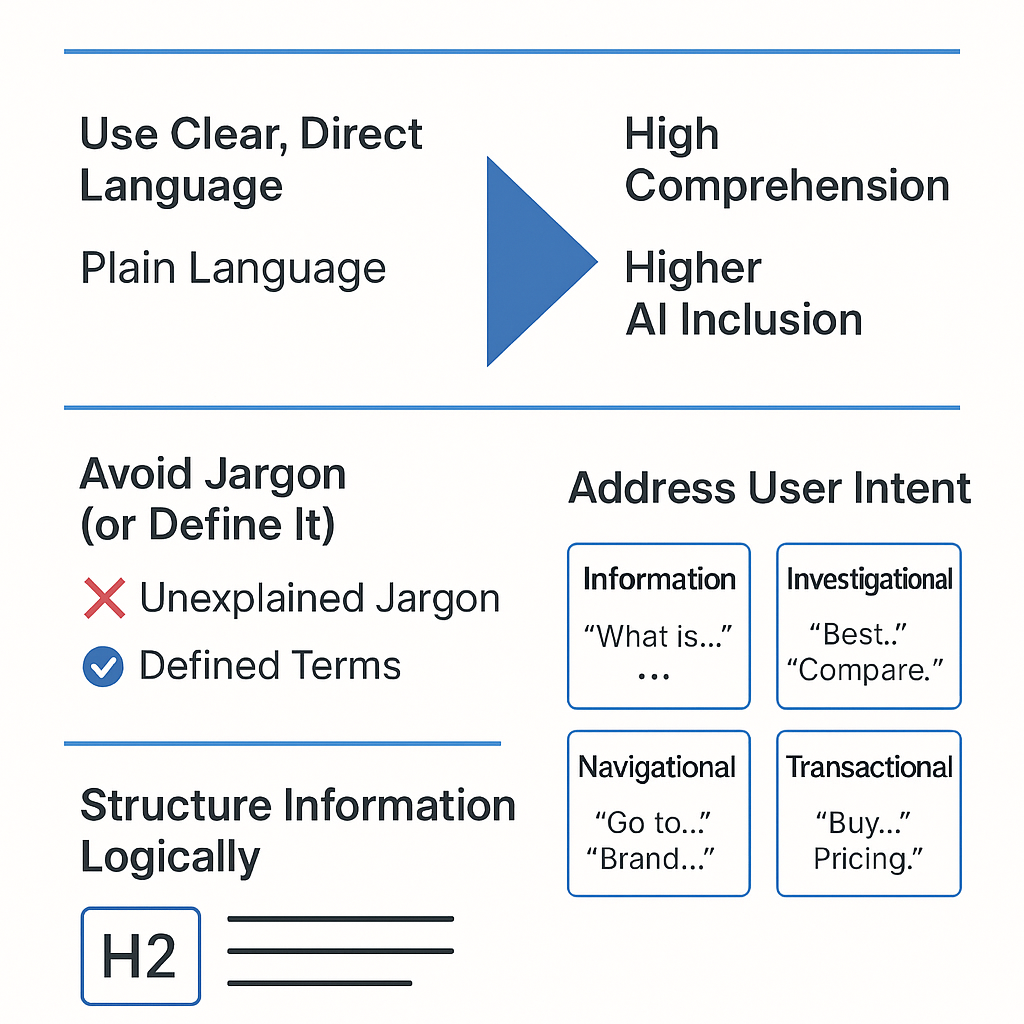
AI models prefer content they can easily parse and reuse.
That means:
Models often copy these elements almost verbatim into their answers.
Structured content isn’t just a convenience — it’s a ranking factor in the AI world.
2. Semantic Precision
AI systems extract meaning, not keywords.
Pages should:
Semantically tight paragraphs dramatically increase inclusion rates.
3. Entity Optimization
Generative models rely heavily on knowledge graphs.
A “high-entity-density page” performs better because AI can:
Good GEO content includes:
4. AI-Friendly On-Page Structure
The ideal GEO article follows a specific pattern:
Unlike long-form “SEO filler,” GEO prefers dense informational blocks that the model can easily absorb.
5. Source Authority
Generative engines value credible sources.
Key signals include:
Authority doesn’t guarantee inclusion — but lack of authority guarantees exclusion.
Types of Content That Perform Best in GEO
Certain content types are inherently “AI-preferred”:
Perfect for definitions used in AI summaries.
Specs, formulas, conditions, parameters. Technical explanations should highlight the key factors that influence outcomes or performance, as these are often extracted by generative engines. Generative AI engines work by leveraging large language models trained on vast datasets to understand and generate contextually relevant technical explanations.
AI loves structured contrasts. Generative engines often synthesize information from multiple web pages to create comprehensive comparison and review summaries.
Step-by-step logic aligns with how generative models answer questions. Analyzing search behavior can help identify the most relevant how-to topics for generative engine optimization.
AI often takes entire Q&A blocks directly into the generated answer. Structuring FAQs around natural language queries increases the likelihood of being included in AI-generated responses.
Tables, statistics, research findings — models cite these frequently. Data analysis is essential for generating the unique insights and statistics that generative engines prefer to cite.
Generative search often produces curated suggestion lists. Sharing these top lists and recommendations on social media platforms like LinkedIn and Medium can leverage social media to further increase their visibility and influence in generative engine results.
Long-tail queries especially benefit from GEO since AI merges related intents.
How to Optimize Your Website for AI Search (GEO Framework)
Below is the most actionable GEO process used by modern SEO teams today.
Step 1: Create GEO-Ready Text Blocks
Each important page should include:
A clear, 2–3 sentence explanation placed at the top.
Definition blocks should distinguish between traditional search engine optimization (SEO) and generative engine optimization (GEO) to help AI models understand the context.
Models love structured numbers and comparisons. Including keyword rankings and other performance metrics in fact tables can enhance their value for generative engines.
Especially for benefits, features, steps. Bullet lists can also effectively summarize key points from user generated content, making these insights more accessible to generative engines.
5–10 questions with compact answers. Well-structured FAQ sections are frequently included in AI responses, increasing the likelihood of your content being cited.
A short recap at the bottom to increase AI extractability. Including summary blocks can also improve your content’s visibility in generative engine results, making it easier for AI and search algorithms to discover and interpret your content. Incorporating visual and interactive elements, such as infographics or videos, in summary blocks can further enhance your content's visibility in generative engine results.
Examples:
Generative engines prefer citing the most informative page, not the highest ranking one. Providing unique data, such as original statistics or exclusive research, can significantly boost source visibility in AI-generated responses.
AI engines often strip referrers, resulting in increases in direct or unknown traffic (often referred to as AI traffic). Using an AI Search Grader tool can help evaluate and benchmark your website’s visibility in AI-powered search engines.
SGE activates thousands of new blended queries. Google Search Console provides valuable insights into how your content is performing in Google Search, including long-tail impressions and keyword rankings.
These appear occasionally in output.
Several startups now track SGE and generative visibility. These tools are designed to monitor visibility and performance in AI powered search engines.
GEO becomes the new organic battlefield.
Similar to Search Console, but AI-focused. While traditional SEO dashboards focus on tracking rankings within search engine results pages, GEO dashboards will track inclusion in AI-generated answers.
Fresh content will gain an advantage. Frequent indexing allows AI models to rank and index content more efficiently, improving the chances of being included in AI-generated responses.
Unstructured text will simply not be read. Incorporating structured data, such as schema markup, is essential to ensure your content is accurately understood and included in AI-generated summaries.
As essential as technical SEO or content strategy. Keyword research is still crucial for identifying the conversational queries, questions, and long-tail topics that generative engines are likely to prioritize.
The organizations that adapt first will dominate entire categories because AI rewards clarity,
Conclusion
Generative Engine Optimization is the next evolution of search.
Unlike traditional SEO, GEO focuses on:
Your job isn’t just to rank.
Your job is to feed the AI with the information it wants.
Those who adopt GEO early will gain an enormous advantage in visibility, traffic, and brand authority as AI search becomes the default.
Your new AI assistant will handle monitoring, audits, and reports. Free up your team for strategy, not for manually digging through GA4 and GSC. Let us show you how to give your specialists 10+ hours back every week.
Read More
December 12, 2025
December 10, 2025
December 9, 2025
Just write your commands, and AI agents will do the work for you.