
December 11, 2025
Generative Engine Optimization (GEO): The Complete Guide to Ranking in AI Search
December 10, 2025
Answer Engine Optimization (AEO): Complete Guide to Dominate AI-Powered Search in 2026
December 9, 2025

Author:
.png)
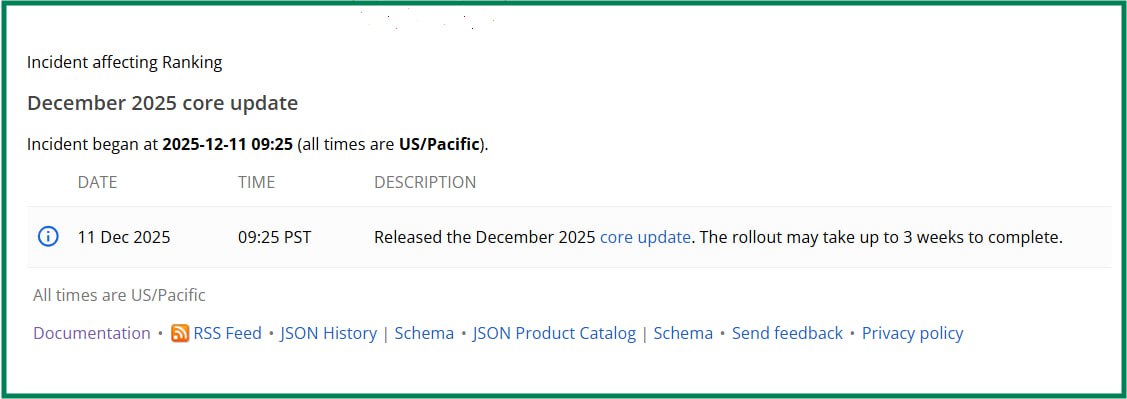
On December 11, 2025, Google officially announced and released the December 2025 Core Update via the Google Search Status Dashboard. Google used the dashboard to confirm the start of the update and will confirm when the rollout is complete. The update began to roll out on that date, and, as with previous core updates that happen periodically, Google noted that the rollout may take up to three weeks to complete. Core updates typically roll out over the course of a week or sometimes longer, and volatility in search results is often observed during this week. The December 2025 Core Update is a significant algorithm update, designed to improve the overall quality and relevance of search results.
This announcement immediately triggered volatility across search results, renewed anxiety in SEO circles, and the familiar question from businesses: “What should we do right now?”
This article aims to answer that question calmly and realistically. We will look at what this December update actually represents, how it differs from smaller algorithm changes, which types of sites are most likely to feel the impact, and what actions make sense both during and after the rollout. Most importantly, we will separate noise from signal—because core updates are rarely about quick fixes.
A Google core update is not a penalty, and it is not a manual action. It is a broad reassessment of how Google’s systems evaluate relevance and quality across the web. A core update is a change to Google’s search algorithms, and is a regular update designed to improve the quality of Google search results. When a core update rolls out, Google is essentially recalibrating its understanding of what content best satisfies user intent for a wide range of queries.
This distinction matters. Many site owners assume that a drop in rankings means they have done something wrong. In reality, it often means that other content has become relatively more relevant under the new evaluation framework. Core updates often involve changes to the importance or weighting of various ranking factors, which can shift how different pages perform in search results. Google itself has used the analogy of an exam: the questions stay the same, but the grading criteria evolve. Some answers that once scored well no longer stand out. A major core update, like those officially announced by Google, differs from smaller core updates that happen more quietly and continuously. Previously, past updates have shown that both types can impact rankings, but major core updates tend to be more noticeable.
The December 2025 Core Update fits squarely into this pattern. It is not targeting a specific tactic such as links, page speed, or AI-generated content. Instead, it is part of Google’s ongoing regular update process, reshaping how multiple signals are weighted together.
According to Google, the update began on December 11, 2025 at 09:25 PST and may continue rolling out for up to three weeks. Google confirmed the update within hours of its initiation. That places the stabilization period somewhere around late December or early January, which is important when interpreting data. Fluctuations during this window are expected and should not be treated as final outcomes. High SERP volatility is typically observed during core updates, so ranking changes in this period are common and often temporary.
Historically, December core updates tend to be disruptive because they overlap with seasonality, holidays, and reduced team availability. This makes knee-jerk reactions especially dangerous. Any serious analysis should wait until the rollout is complete and the SERPs settle. The March and June core updates earlier in 2025 set the stage for this December update, which is the third core update of the year.
That said, even in the early stages, certain patterns are already familiar.
While Google rarely explains the internal mechanics of a core update, the direction has been consistent for years. Google’s systems are continually making updates and learn from ongoing changes, some of which are not widely noticeable but can still impact rankings. The December 2025 update appears to continue several long-term trends rather than introduce something radically new. One of the main objectives of core updates is to improve overall search quality.
One of the strongest signals is the growing emphasis on demonstrated experience and depth, rather than surface-level coverage. Content that simply aggregates what already exists in the SERP—without adding new perspective, insight, or clarity—is increasingly fragile. This applies whether the content is written by humans or generated with AI.
Another visible trend is the reinforcement of topical authority. Sites that focus deeply on a narrow set of subjects tend to perform better than sites that publish broadly across unrelated topics. Google seems increasingly confident in evaluating whether a site “belongs” in a given topical space.
Finally, there is less tolerance for outdated content. Pages that have not been meaningfully updated in years, especially in fast-moving niches, are more likely to lose ground—even if they once performed well.
Experience, Expertise, Authoritativeness, and Trustworthiness—collectively known as E-E-A-T—have been discussed by Google for a long time. E-E-A-T helps Google surface relevant and satisfying content for searchers, improving the quality of search results. Google's quality rater guidelines provide the framework for evaluating E-E-A-T in content. What has changed is how concretely these qualities are reflected in rankings.
In 2025, E-E-A-T is no longer about adding an author box or an “About Us” page and calling it a day. Google is better at detecting whether content reflects real-world understanding, practical insight, and consistent subject-matter focus. Pages that feel generic, interchangeable, or written purely to satisfy SEO requirements struggle to compete against content that shows genuine familiarity with the topic.
This is particularly noticeable in informational queries, guides, comparisons, and decision-making content. The more a page claims to help users choose, decide, or understand something important, the higher the expectations are.
The December 2025 Core Update does not affect all sites equally. Based on historical behavior and early observations, the most vulnerable sites tend to share certain characteristics. Sites with these characteristics are often hit by core updates, resulting in a drop in their search position.
Sites built on large-scale, low-differentiation programmatic content are one example. Programmatic SEO itself is not a problem, but pages that exist solely to capture long-tail keywords without offering meaningful value are increasingly exposed. If thousands of pages differ only by a city name, product variation, or minor phrasing change, Google may struggle to justify ranking all of them highly.
Another risk group includes sites with “checkbox content”—articles that technically answer a question but do so in the shallowest possible way. These pages often summarize what others have written without adding original structure, examples, or interpretation. Such pages are considered thin content, which are particularly vulnerable during core updates. They may still be factually correct, but correctness alone is no longer enough.
Finally, content that has clearly aged without maintenance is more likely to decline. Google’s understanding of freshness is contextual, but in many niches, outdated recommendations or examples are a strong negative signal.
On the other side of the equation, sites that demonstrate clear topical focus and consistency often benefit from core updates. When a site repeatedly publishes high-quality content around a specific domain, Google gains confidence in its authority within that space. Content improvements can lead to a rise in search rankings, and site owners hope for positive outcomes after the update.
Content that genuinely solves user problems tends to perform well, even if it is not perfectly optimized in a traditional SEO sense. Pages that are easy to follow, logically structured, and written with real users in mind often outperform more aggressively optimized competitors.
It is also worth noting that some sites see delayed benefits. A core update may initially cause volatility, but once the rollout completes, well-aligned sites sometimes gain visibility weeks later as Google’s systems fully settle. These sites often see an increase in organic visibility as a result.
One of the biggest mistakes during a core update is overreaction. Making large-scale changes while rankings are still fluctuating can make it impossible to understand what actually caused a drop or recovery. Site owners should carefully analyze data from tools like Search Console to determine whether changes in traffic or rankings are actually related to the core update before taking any action.
Rewriting entire sections of a site, changing internal linking structures, or launching major content overhauls mid-rollout often creates more confusion than clarity. Similarly, chasing daily ranking changes or reacting to every dip usually leads to poor decisions.
Core updates are not debugging exercises. They are evaluation shifts. Treating them as technical incidents is a misunderstanding of how Google search works.
The most productive response during the rollout phase is observation. Ranking fluctuations are common during this period and should be expected. This is the time to establish a baseline, monitor changes calmly, and look for patterns rather than individual keyword movements.
If traffic or visibility drops, the first question should not be “How do we fix this quickly?” but “What exactly declined?” Often, only certain content types, intents, or sections are affected. In many cases, commercial pages remain stable while informational content fluctuates, or vice versa.
Equally important is analyzing which competitors are gaining visibility. Understanding why they are winning often reveals more than dissecting one’s own losses. Core updates are relative by nature, and improvement usually means closing gaps rather than undoing mistakes.
If you’ve noticed any changes or have insights about how the google core update has impacted your site, please comment below and share your experience.
Once the December 2025 Core Update has fully rolled out and rankings stabilize, more decisive action becomes appropriate. This is the moment to reassess content quality at a structural level rather than chasing individual keywords. At this stage, it is recommended that site owners perform a comprehensive site audit to identify areas for improvement.
Improving depth, clarity, and usefulness should take priority over producing more pages. In many cases, consolidating overlapping content and strengthening a smaller number of strong pages is more effective than publishing at scale. Updating older articles with fresh insights, examples, and clearer explanations can also yield significant gains.
From a site-wide perspective, reinforcing topical coherence helps. When internal linking, content hierarchy, and editorial focus all point in the same direction, Google’s confidence in the site tends to increase.
Google’s services, such as the Search Status Dashboard, can help site owners monitor changes and understand how updates may affect their account or site performance. Trust signals matter as well. This does not mean adding empty claims of expertise, but rather making it easier for users—and search engines—to understand who is behind the content and why they should trust it.
One of the most common concerns around recent core updates is the role of AI-generated content. The December 2025 update does not signal a blanket rejection of AI. The increasing prevalence of content automation raises important questions about maintaining high content quality. Google has repeatedly stated that it evaluates content based on quality and usefulness, not how it was produced.
A recent video analyzing the update demonstrated how sites using AI-generated articles without editorial review saw significant ranking drops. Similarly, a story shared by a search marketer highlighted how a site improved its rankings by combining AI tools with expert human input and unique insights.
However, AI has made it easier than ever to publish large volumes of average content. Core updates increasingly expose the limitations of that approach. Pages that rely on AI without strong editorial oversight, real-world context, or added value are more likely to struggle.
Used thoughtfully, AI can still be an advantage. Used as a shortcut, it becomes a liability.
For founders, product leaders, and marketing executives, core updates can be frustrating. Traffic drops feel urgent, and the instinct is often to demand immediate action. The reality is that core updates reward long-term alignment, not short-term fixes.
Pressuring teams to “do something now” during a rollout often leads to wasted effort. A better approach is to allow time for analysis, support evidence-based decisions, and focus on sustainable improvements rather than reactive changes. It’s important to remember that improvements in search rankings do not necessarily require waiting for a major core update—ongoing, smaller changes and content refinements can also have a positive impact.
Search visibility is increasingly a reflection of overall product quality, content strategy, and brand credibility—not just SEO tactics. A well-defined SEO strategy is essential for adapting to core updates and ensuring long-term success.
The December 2025 Core Update is not an outlier. It is part of Google’s ongoing effort to reward content that is genuinely useful, trustworthy, and grounded in real expertise. While short-term volatility is unavoidable, the long-term direction is consistent and predictable.
Sites that invest in clarity, depth, and relevance tend to recover—even if they experience temporary declines. Those that rely on volume, shortcuts, or surface-level optimization face growing headwinds.
In that sense, this update is less a disruption and more a reminder: sustainable SEO is built on understanding users, not algorithms. Google’s systems are simply getting better at enforcing that principle. As Barry Schwartz, a respected authority in the SEO industry, often notes, the true impact of core updates is seen over time, and focusing on quality remains the best long-term strategy.
Your new AI assistant will handle monitoring, audits, and reports. Free up your team for strategy, not for manually digging through GA4 and GSC. Let us show you how to give your specialists 10+ hours back every week.
Read More
December 11, 2025
December 10, 2025
December 9, 2025
Just write your commands, and AI agents will do the work for you.