
December 12, 2025
Understanding the Google Core Update of December 2025: What It Means, Who It Affects, and How to Respond
December 11, 2025
Generative Engine Optimization (GEO): The Complete Guide to Ranking in AI Search
December 10, 2025

Author:
.png)
B2B SEO used to treat relevance as a function of content templates, keywords, and backlinks. AI search fundamentally changed that system.
In 2025, AI models identify brands through distributed patterns rather than page-level heuristics. One of the strongest signals is co-citation, where brands and products are repeatedly mentioned together in similar problem spaces. When a vendor appears consistently across independent sources like industry lists, comparison pages, and directories, large language models strengthen the entity’s authority at a systems level.
Mention frequency is the new authority layer. It works as an implicit ranking signal — the more consistently a brand appears in similar vendor narratives, the stronger its semantic salience for AI engines.
Another key factor is entity consistency. When core details like product categories, vendor descriptions, industry associations, or business attributes remain stable across platforms, AI models create clean embeddings for the brand without ambiguity. This boosts retrieval probability in future B2B vendor lists and AI search recommendations.
Lastly, AI engines compute vendor understanding in a language-agnostic way. This means global vendors gain authority faster — mentions across multiple languages strengthen the entity without fragmenting it, as long as the context signals remain aligned.
The shift is clear:
B2B vendor relevance is now based on structured brand recall — not keyword recall. AI models don’t store pages. They store trust graphs.
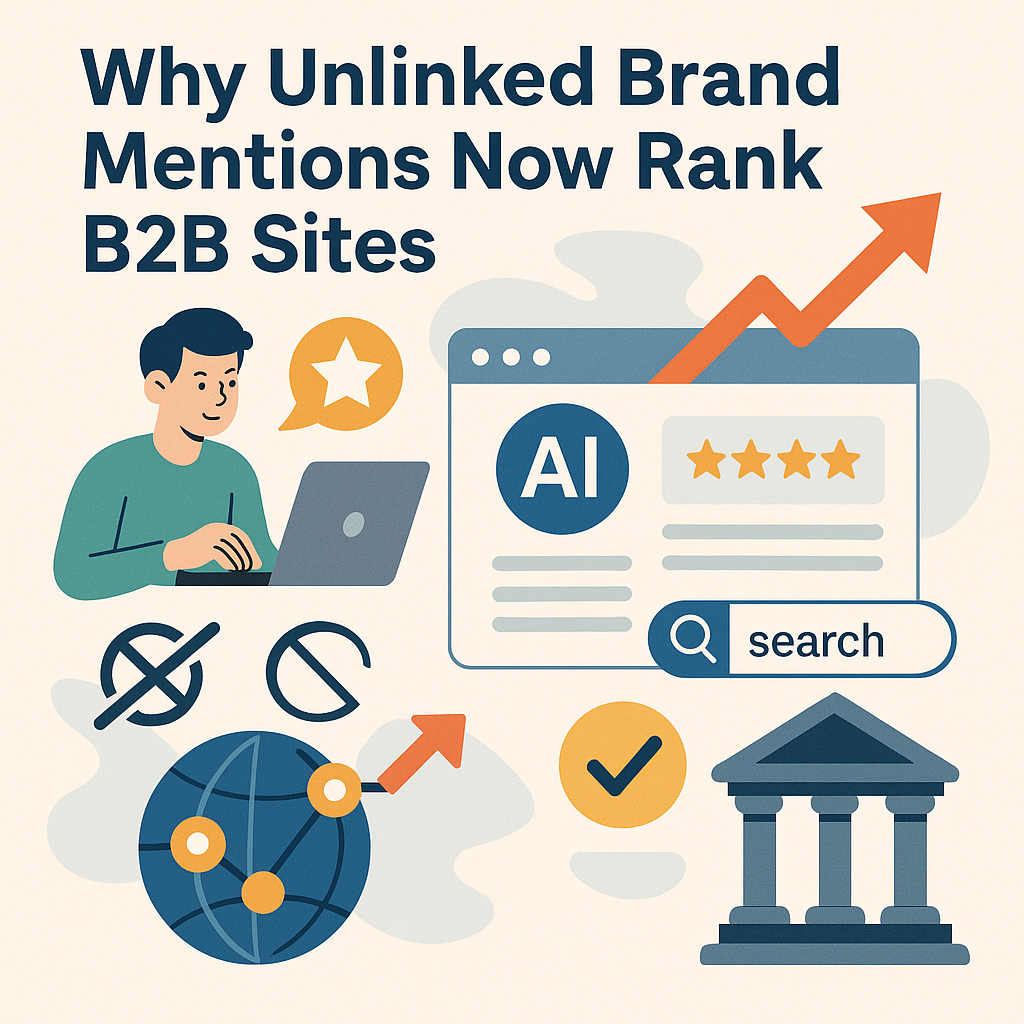
Perplexity, SearchGPT, and Bing Copilot don’t evaluate ranking as a static search result position — they evaluate inclusion probability in AI-generated vendor recommendation pools.
Even without backlinks, AI models reconstruct reputation using correlated signals from external sources. That’s why unlinked mentions now contribute to B2B SEO. AI uses these mentions to build probabilistic confidence around a vendor’s reliability, solution relevance, and perceived expertise.
This introduced a new ranking paradigm:
Reputation recall beats keyword recall. A brand mentioned across trusted third-party content clusters or industry lists, even without links, becomes easier for models to confidently recommend during enterprise-level product evaluations.
Another AI input feature SEOs overlook is branded search lift. When B2B buyers increasingly search for vendors directly, the rising volume of brand-driven enterprise queries becomes a trust signal for AI relevance — boosting the vendor’s salience as a likely best-fit solution for future recommendations.
Important nuance:
AI models prioritize recommendation precision. Google prioritized URL precision.
This forces B2B SEO to evolve into brand-level knowledge management. It’s not about acquiring mentions. It’s about structuring them meaningfully and consistently.
AI citation engines are transforming B2B brand discovery, and companies must adapt fast.
In 2025, AI doesn’t just crawl your site — it evaluates your brand as a connected company entity. To increase inclusion in AI answers, your business profile must be structured, consistent, and machine-readable across the web.
The strongest competitive advantage comes from building clean entity embeddings. This happens when your company name, industry, product categories, descriptions, address details, and official business attributes stay aligned across all platforms. The result? AI models retrieve you faster when composing vendor recommendations or comparisons.
Next, AI favors product proof chunks. These are concise blocks of evidence that confirm vendor reliability — customer testimonials, security certifications, product screenshots with clear text, verified review summaries, compliance statements, or measurable outcomes. These chunks serve as AI-ready validators, far more powerful than generic keyword-rich text.
Another overlooked ranking enabler is review sentiment aggregation. Tools that cluster, validate, and summarize user reviews provide a distributed reputation signal that models extract and reuse. Positive sentiment continuity improves AI’s confidence when recommending your brand.
Lastly, keep your knowledge highly citabile. Comparison blocks, FAQ statements, definitions, and product spec tables should be concise and quote-friendly. These citation-optimized knowledge blocks make your content ideal for extraction and reuse in AI summaries like Google AI Overviews or SearchGPT.
Freshness feeds the models now. AI favors sources updated dynamically — this includes syncing product details, business hours, pricing, or key data through structured APIs. That’s why B2B SEO ecosystems increasingly rely on API-fed real-time updates — models treat recently modified content as more reliable for enterprise-grade insights.
B2B brand pages don’t compete for position #1 anymore.
They compete for being chosen, cited, and recommended.
Traditional ranking tracking tools only tell part of the story.
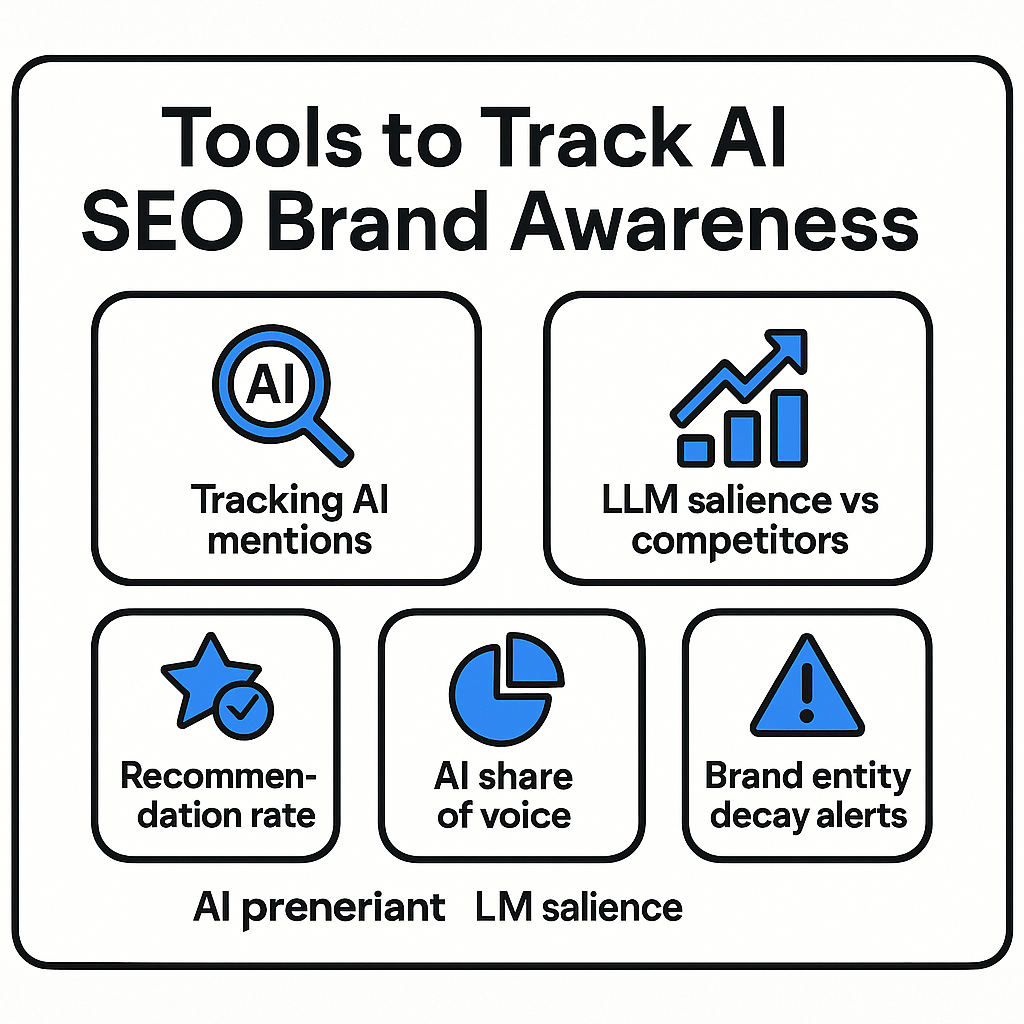
AI visibility measurement needs a deeper competitive framework.
First, SEOs must track AI mentions. Every time your brand appears in systems like SearchGPT, Bing Copilot, Google AIO answers, or Perplexity, these aggregated touchpoints build linguistic authority and relevance recall. Tracking software must measure this to detect early visibility wins or gaps.
Second, successful tools measure LLM salience vs competitors. It’s no longer about keyword overlap — it’s about entity overlap inside AI answers. Who appears most frequently for the same intents? Who is cited most reliably across languages? That’s vendor-level salience, and it must be benchmarked continuously.
Another core KPI is recommendation rate benchmarking. Tracking how often AI engines suggest your business relative to alternatives will become a primary ranking index metric by 2026.
Then, evaluate AI share of voice. Parsing your brand’s presence inside Google AI Overviews or Perplexity vendor answers helps you understand competitive inclusion accuracy. Tools must extract, cluster, and quantify recommendation frequency and topic inclusion rate inside long-tail AI searches.
Finally, build alerting systems for entity risks. Brand entity decay alerts notify you when your business details conflict across sources, lose sentiment continuity, or decline in citation recall. These alerts let teams refresh content clusters before rankings decay in the models themselves.
The next generation of SEO tools will score visibility like this:
B2B SEO is no longer a channel.
It’s a knowledge ecosystem, ranked by machines that predict trust, not just links that pass authority.
In the AI-search era, your brand entity footprint matters more than link footprint. AI engines build confidence from correlated entity trails: vendor lists, product clusters, review graphs, and industry co-mentions. A strong entity footprint has 3 properties: verifiable, coherent, and repetitive in similar solution contexts. Modern SEOs now score brands by their entity footprint density, not domain density — a metric that predicts how confidently AI will pull the brand into recommendation pools for a given JTBD intent.
Your new AI assistant will handle monitoring, audits, and reports. Free up your team for strategy, not for manually digging through GA4 and GSC. Let us show you how to give your specialists 10+ hours back every week.
Read More
December 12, 2025
December 11, 2025
December 10, 2025
Just write your commands, and AI agents will do the work for you.