
December 12, 2025
Understanding the Google Core Update of December 2025: What It Means, Who It Affects, and How to Respond
December 11, 2025
Generative Engine Optimization (GEO): The Complete Guide to Ranking in AI Search
December 10, 2025

Author:
.png)
AI-powered search has fundamentally changed how content is discovered and ranked. Traditional on-page SEO was built around keyword matching, linear SERPs, and link signals. But AI models don’t evaluate pages the way classic search engines did.
Today’s ranking logic has shifted toward:
semantic relevance → answer quality → model fit.
Google AI Overviews (AIO), SearchGPT, Perplexity, and Bing Copilot all use their own relevance scorers — systems that evaluate how well a piece of content satisfies a specific question, intent, or informational gap.
The core shift is simple but dramatic:
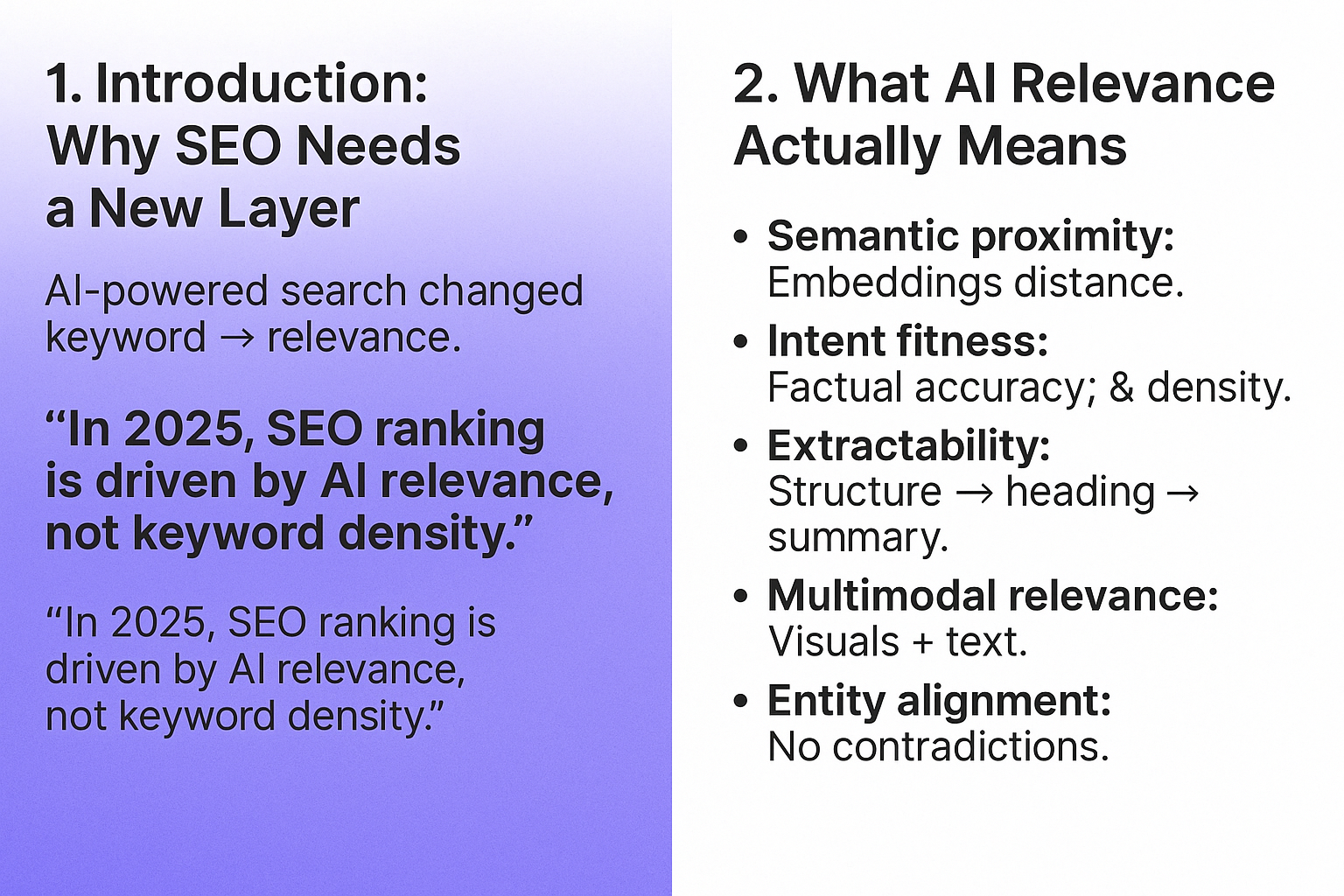
“In 2025, SEO ranking is driven by AI relevance, not keyword density.”
Search engines are no longer only deciding which pages to show.
AI models decide which blocks, answers, facts, visuals, and entities are relevant enough to cite, summarize, or recommend.
This new layer sits above traditional SEO — and it’s called AI Relevance Optimization (AIRO).
AI relevance measures how well your content fits what a model expects to use as a correct, factual, and complete answer.
Это не про “сколько раз повторён ключ”. Это про то, насколько глубоко контент соответствует смыслу запроса.
AI relevance includes several dimensions:
How close your content’s embeddings are to the query embeddings.
(Впервые в истории SEO “близость смыслов” стала реальным фактором ранжирования.)
Does the block fully match why the user asked the question — not just what they typed?
AI prioritizes content with numbers, definitions, comparisons, and concrete facts because оно уменьшает вероятность галлюцинаций.
Models prefer blocks built like this:
AI doesn’t want to “think too long”.
Оно выбирает то, что проще извлечь.
Visuals (images, screenshots, diagrams, UI flows) become signals:
they confirm expertise, clarify meaning, and give AI дополнительный контекст для ответа.
AI cross-checks your brand across the web.
Если данные противоречат друг другу → trust score падает → контент теряет relevance.
AI now evaluates everything Google never checked: factual density, semantic structure, visual clarity, entity coherence, and block-level meaning.
Modern AI search engines (Google AIO, SearchGPT, Perplexity) follow a completely different pipeline from classic search engines. Instead of ranking full pages, they rank units of meaning.
Here’s the actual process:
The AI scans the web and retrieves the most relevant sections of content — not entire URLs.
It pulls paragraphs, definitions, lists, diagrams, and FAQs as separate candidates.
The retrieved content is split into semantic chunks (usually 150–400 tokens).
Each chunk is treated like a standalone “micro-page” and evaluated independently.
Every chunk receives an AI relevance score, based on:
This score determines whether your block becomes a candidate for an answer.
Only the highest-scoring chunks are:
AI doesn’t care about the whole page — only about the best chunk inside it.
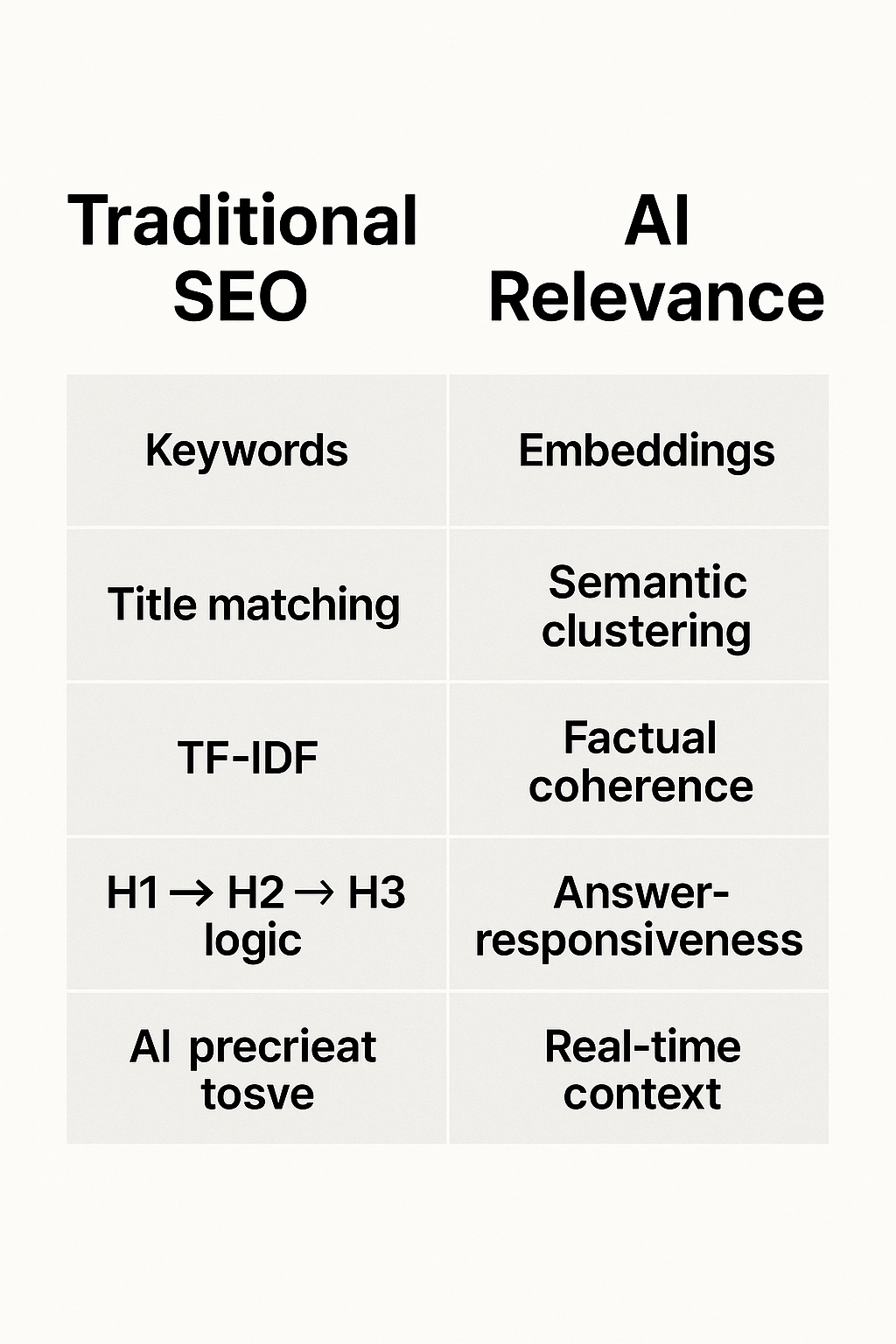
Classic SEO relevance and AI relevance are two completely different systems.
This worked when Google ranked pages.
AI models compare meanings, not strings of text.
Your content must be semantically close to the intent — not just contain the keyword.
Models group related concepts.
If your content doesn’t “fit” the knowledge cluster, it won’t be shown.
AI penalizes contradictions, outdated stats, or unclear sources.
A single strong block can outrank a full 3000-word article.
LLMs rank blocks based on how directly and efficiently they answer the query.
AI can blend data from multiple sources, not rely on one page.
Traditional SEO optimized for keywords.
AI SEO optimizes for answers.
Every block on the page must answer one specific question.
AI models reward ultra-precise intent matching, not broad paragraphs.
LLMs process content in semantic chunks (200–400 words).
Well-defined, self-contained chunks rank significantly higher in AI systems.
AI prioritizes blocks rich in:
Thin descriptive text loses to dense, evidence-based content.
AI should be able to “pull” an answer instantly.
Best formats:
If the model can extract the key point in 1–2 seconds → your block wins.
AI checks whether your information is consistent across:
Aligned entities → higher trust → higher AI relevance.
This is the workflow used by modern AI search engines—and it’s replacing traditional on-page SEO.
The next generation of SEO KPIs will be AI-centric:
These metrics will soon become standard across major SEO platforms.
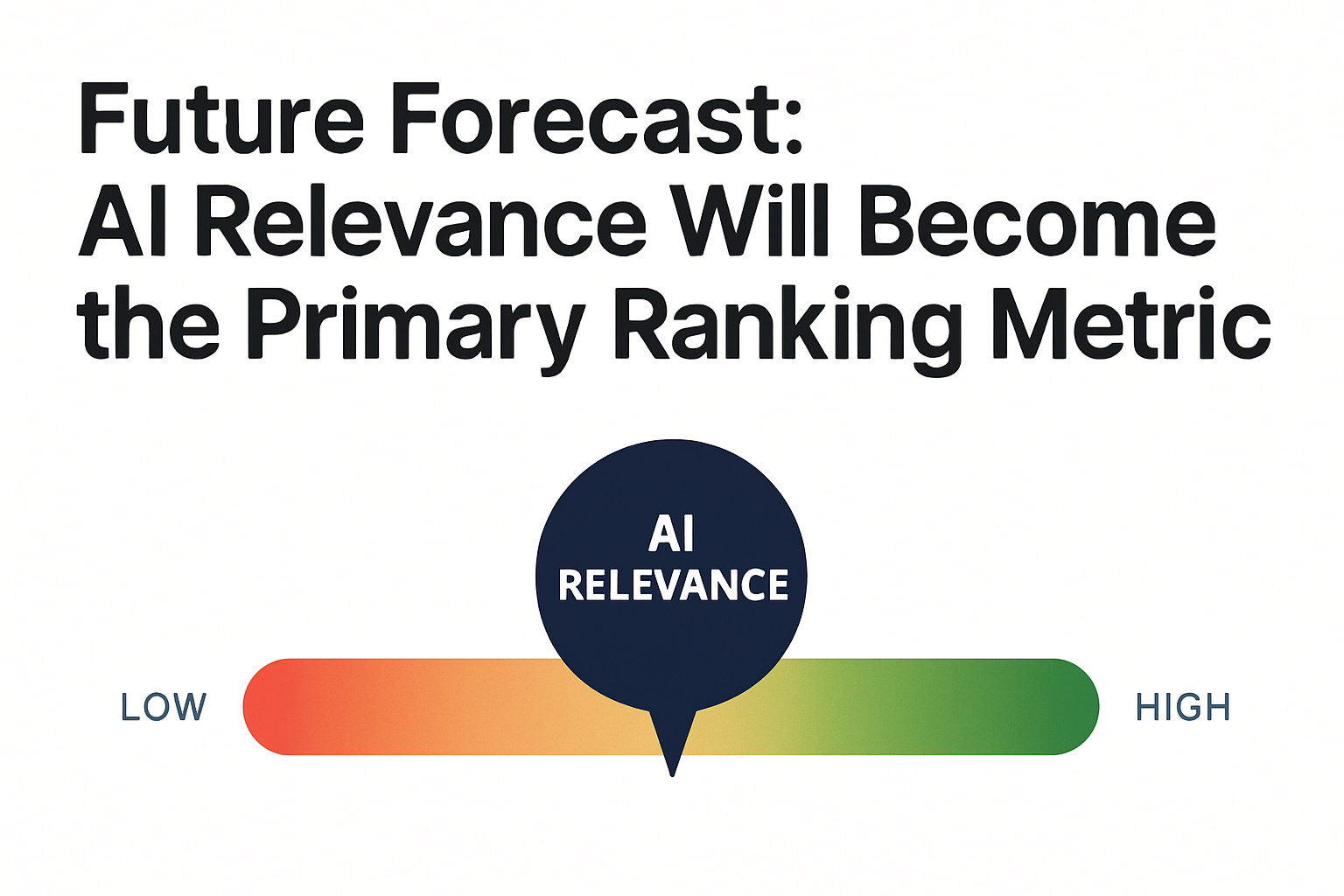
AI relevance is not a side trend — it’s the beginning of a new ranking era.
Google is already testing relevance-based scoring inside AI Overviews, where content is selected purely based on semantic fit, factual grounding, and extractability. Traditional keyword signals play a secondary role.
SearchGPT and Perplexity have gone even further — they only rely on AI relevance to choose which blocks to cite, summarize, or recommend. URLs matter less; what matters is how well your content aligns with the model’s internal knowledge graph.
This shift will transform competition in SEO:
Over the next 1–2 years, AIRO (AI Relevance Optimization) will become the primary battlefield of SEO.
Teams that master semantic blocks, factual density, entity alignment, and multimodal signals will dominate both AI search and traditional search.
The future of ranking is clear:
AI relevance becomes the metric — everything else becomes supporting signals.
Your new AI assistant will handle monitoring, audits, and reports. Free up your team for strategy, not for manually digging through GA4 and GSC. Let us show you how to give your specialists 10+ hours back every week.
Read More
December 12, 2025
December 11, 2025
December 10, 2025
Just write your commands, and AI agents will do the work for you.