
December 12, 2025
Understanding the Google Core Update of December 2025: What It Means, Who It Affects, and How to Respond
December 11, 2025
Generative Engine Optimization (GEO): The Complete Guide to Ranking in AI Search
December 10, 2025

Author:
.png)
Google’s AI overviews have fundamentally changed how users discover content online. These AI-powered answer boxes now appear above traditional search results in over 100 countries, synthesizing information from multiple sources to provide comprehensive responses to user queries.
The impact on search engine optimization has been profound. While traditional blue links still matter, the real competition now centers around becoming one of the few sources that AI algorithms select as trustworthy and relevant enough to cite in their generated answers.
This shift represents more than just another SERP feature—it’s a fundamental change in how search engines operate. Instead of simply ranking pages, search engines now use retrieval-augmented generation to create custom answers by reading and synthesizing content from across the web.
In this guide, you’ll learn the exact strategies and techniques needed to optimize your content for AI overview inclusion, from technical implementations to content structure, along with the tools to track your success.
Google AI overviews, formerly known as Search Generative Experience, represent a new paradigm in search engine results pages. These AI-generated answer blocks appear at the top of search results, providing users with synthesized information drawn from multiple web sources.

Unlike traditional featured snippets that extract content from a single source, AI overviews use large language models to read, understand, and synthesize information from multiple documents simultaneously. The system then generates a natural language response while citing the most relevant and trustworthy sources.
The mechanics behind AI overviews involve several key steps:
The impact on organic click-through rates has been significant. For informational queries where AI overviews provide comprehensive answers, traditional organic results see reduced clicks, particularly for simple fact-based queries. This makes appearing as a cited source in AI overviews crucial for maintaining search visibility.
Statistical insights reveal the scope of this change:
For SEO practitioners, this creates a dual optimization challenge: maintaining traditional organic rankings while simultaneously optimizing for generative engine optimization. The websites that succeed in both areas will dominate future search visibility.
The shift toward answer engines rather than simple link directories means that content must now serve two masters: human readers seeking detailed information and AI systems requiring clear, structured, and authoritative sources to synthesize from.
Understanding what drives AI overview selection requires examining the intersection of traditional ranking signals with new AI-specific criteria. Search engines evaluate potential sources through multiple lenses before including them in generated answers.
E-E-A-T signals form the foundation of trust evaluation. Google’s emphasis on Experience, Expertise, Authoritativeness, and Trustworthiness becomes even more critical when AI systems select sources for sensitive topics. For Your Money or Your Life (YMYL) content—covering health, finance, legal, and safety topics—the quality thresholds are particularly high.
Demonstrating experience involves including author credentials, firsthand practice references, and transparent methodology for any claims or data presented. Expertise manifests through depth of explanation, correct terminology usage, and citations to established research or industry standards.
Content quality and factual accuracy requirements exceed traditional SEO standards. AI systems are designed to avoid hallucination and misinformation, making accuracy verification a critical factor. Content that contains contradictions, outdated information, or unsubstantiated claims is less likely to be selected as a reliable source.
The quality bar includes several measurable elements:
Search intent alignment drives retrieval into AI contexts. The system must first understand that your content directly addresses the user’s query intent before it can be considered for synthesis. This goes beyond keyword matching to include semantic relevance and contextual appropriateness.
Intent classification typically falls into categories like informational (“learn basics”), commercial investigation (“compare options”), or local intent (“find providers nearby”). Content must tightly align with the primary intent class where AI overviews commonly appear—usually informational or complex commercial queries.
Page authority and domain reputation metrics still matter significantly. While AI overviews can surface content from smaller sites with exceptional relevance, authority signals help filter out low-quality sources during the initial retrieval phase.
Traditional ranking factors continue to influence selection:
Structured data and schema markup provide crucial machine-readable signals. By implementing appropriate schema.org markup, sites give AI systems clear context about content type, purpose, and relationships between different page elements.
The most impactful schema types for AI overview optimization include:
Schema Type
Purpose
AI Overview Benefit
FAQ Schema
Maps question-answer pairs
Direct question matching
Article Schema
Defines content structure
Context understanding
HowTo Schema
Outlines step-by-step processes
Procedural query optimization
Product Schema
Provides item specifications
Comparison and recommendation queries
Organization Schema
Establishes entity relationships
Authority and trust signals
These technical signals work in combination rather than isolation. A page might rank well organically but lack the structured clarity needed for AI synthesis, or conversely, have excellent schema markup but insufficient authority for citation in sensitive topics.
Creating content that AI systems prefer requires a fundamental shift in writing and structure. Rather than optimizing primarily for keywords, the focus moves toward directly answering user questions with clarity, comprehensiveness, and authority.
Focus on answering specific questions directly and concisely. AI overviews excel at synthesizing information for complex, multi-part queries. Content that explicitly addresses these compositional questions—combining multiple intent signals into a single comprehensive answer—performs best.
Effective question targeting involves:
Use clear headings (H2, H3) that match common search queries. Heading structure serves as a roadmap for both users and AI systems. Headings formatted as questions (“What is X?”, “How does X work?”, “Benefits and risks of X”) align naturally with query patterns and help AI models locate relevant information quickly.
The heading hierarchy should follow a logical progression:
Include definition paragraphs and explanatory content. Many AI overviews begin with clear definitions before diving into specifics. Providing concise, accurate definitions at the beginning of relevant sections increases the likelihood of citation for definitional queries.
Effective definition content includes:
Optimize for featured snippets as foundation for AI overview inclusion. There’s significant overlap between content that wins featured snippets and content cited in AI overviews. Pages already ranking for featured snippets have a higher probability of AI overview inclusion for related queries.
Featured snippet optimization translates well to AI overview optimization:
Create comprehensive topic coverage without keyword stuffing. AI systems favor content that covers topics thoroughly, addressing the full scope of what an expert would discuss. This means covering definitions, mechanisms, use cases, benefits, risks, and common questions on well-organized pages rather than fragmenting information across multiple thin pages.
Comprehensive coverage should include:
Start sections with direct answers to common questions. The opening paragraph of each section should contain a clear, standalone answer that could be quoted directly in an AI overview. This mirrors the structure that AI systems use when generating responses—leading with the core answer before providing supporting detail.
Effective opening patterns include:
Use bullet points and numbered lists for clarity. AI systems excel at parsing structured information. Lists provide clear delineation between concepts, making it easier for models to extract specific points for synthesis.
Optimize list content by:
Include relevant statistics, dates, and specific data points. Concrete data helps AI systems understand context and currency while providing quotable facts for generated answers. However, data must be accurately attributed and regularly updated to maintain reliability.
Data integration best practices:
Maintain factual accuracy with cited sources. AI systems are designed to avoid generating misinformation, making source quality a key selection criterion. Content with clear attribution to authoritative sources increases trust and citation likelihood.
Source citation should include:
Write in natural, conversational tone that matches user queries. AI overviews aim to sound like helpful, knowledgeable responses rather than formal documentation. Content written in a natural, accessible tone is more likely to be selected for paraphrasing in generated answers.
Conversational optimization includes:
Technical foundation determines whether AI systems can effectively access, understand, and utilize your content. Even the highest-quality content fails to appear in AI overviews if technical barriers prevent proper crawling and interpretation.

Implement FAQ schema markup for question-based content. FAQ schema provides direct mapping between questions and answers that AI systems can easily parse and incorporate into generated responses. This structured data format aligns perfectly with how users phrase queries and how AI overviews are constructed.
Effective FAQ schema implementation:
{
  "@type": "FAQPage",
  "mainEntity": [{
    "@type": "Question",
    "name": "How do AI overviews work?",
    "acceptedAnswer": {
      "@type": "Answer",
      "text": "AI overviews use retrieval-augmented generation to synthesize information from multiple sources..."
    }
  }]
}
Use article schema to help AI understand content structure. Article schema provides context about content type, publication date, author credentials, and organizational relationships. This metadata helps AI systems evaluate source quality and topical relevance.
Critical article schema elements include:
Optimize page loading speed and Core Web Vitals. While not directly confirmed as AI overview ranking factors, page performance affects crawlability and user experience signals that influence overall quality evaluation. Slow-loading pages may be deprioritized during the retrieval phase.
Performance optimization priorities:
Metric
Target
Impact on AI Overviews
Largest Contentful Paint
< 2.5 seconds
Content accessibility
First Input Delay
< 100 milliseconds
Interaction responsiveness
Cumulative Layout Shift
< 0.1
Reading experience
Time to Interactive
< 3.5 seconds
Full content availability
Ensure mobile-first indexing compatibility. With mobile-first indexing as the standard, content must be fully accessible and properly rendered on mobile devices. AI systems likely use mobile-rendered content for analysis and synthesis.
Mobile optimization requirements:
Create clean URL structure and internal linking. Clear site architecture helps AI systems understand content relationships and topical authority. Well-structured internal linking signals which pages are most important and how topics connect to each other.
Effective URL and linking strategies:
The technical foundation also extends to content rendering. JavaScript-heavy frameworks that rely on client-side rendering can create barriers for AI systems accessing content. Server-side rendering or static generation ensures that essential content is immediately available in the HTML payload.
Additional technical considerations include:
These technical elements work synergistically with content quality. A page might have exceptional content but remain invisible to AI overviews due to technical barriers, while another page with solid technical implementation but weak content won’t be selected despite accessibility.
Monitoring your presence in AI overviews requires specialized tools and techniques, as traditional rank tracking doesn’t capture this new form of search visibility. Success measurement involves tracking both inclusion frequency and the quality of citations received.
SE Ranking AI Overview Tracker for monitoring keyword presence provides dedicated tracking for AI overview appearances across your target keyword set. This platform monitors when your content appears as a cited source and tracks competitors’ AI overview performance for comparative analysis.
Key features include:
Rankscale.ai for tracking brand visibility across AI search engines extends monitoring beyond Google to include other AI-powered search platforms like Bing Chat, Perplexity, and Claude. As the AI search landscape diversifies, multi-platform tracking becomes essential.
The platform provides:
Semrush One AI Visibility Overview features integrate AI overview tracking with existing SEO workflows. This approach allows teams to monitor AI performance alongside traditional organic rankings within familiar interfaces.
Integration benefits include:
Manual monitoring techniques using search operators remain valuable for detailed analysis and verification. Understanding how to manually check AI overview performance provides insights that automated tools might miss.
Effective manual monitoring approaches:
Setting up tracking for competitor AI overview analysis reveals successful strategies and identifies gaps in your own optimization. Competitive intelligence in the AI overview space focuses on content structure, topic coverage, and technical implementation patterns.
Competitive analysis frameworks should examine:
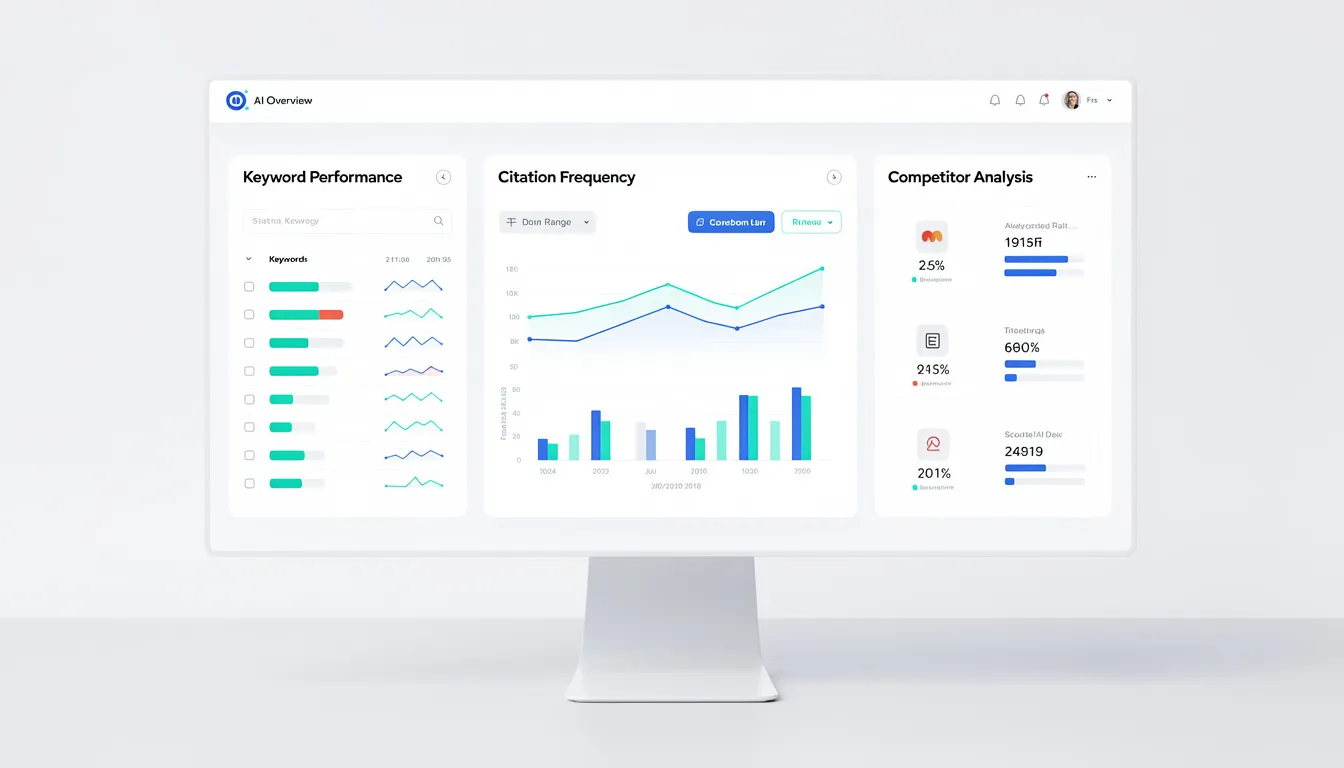
Performance measurement should focus on several key metrics:
Metric
Description
Measurement Method
Citation Frequency
How often your content is cited in AI overviews
Automated tracking tools
Citation Context
Quality and relevance of how your content is referenced
Manual review and analysis
Query Coverage
Breadth of queries triggering AI overviews for your content
Keyword expansion tracking
Competitive Share
Your citation share compared to competitors
Comparative analysis tools
Traffic Impact
Changes in organic traffic correlated with AI overview presence
Google analytics correlation
The measurement landscape continues evolving as AI overviews become more prevalent. Early adoption of tracking methodologies provides competitive advantage, as most organizations haven’t yet developed systematic approaches to AI overview monitoring.
Successful tracking programs combine automated monitoring with manual verification, ensuring data accuracy while scaling observation across large keyword sets. The goal is developing predictive insights about what drives AI overview inclusion rather than merely documenting past performance.
Understanding what not to do when optimizing for AI overviews is as crucial as implementing best practices. Many optimization efforts fail due to misunderstanding how AI systems evaluate and select content for inclusion.
Over-optimizing content with excessive keyword density backfires more severely in AI overview optimization than traditional SEO. AI systems are designed to detect and avoid unnatural language patterns that might indicate manipulation or low-quality content.
Signs of over-optimization include:
AI systems favor content that uses natural language variation and semantic richness. Instead of repeating the same phrases, use synonyms, related terms, and contextual variations that demonstrate topical expertise.
Creating AI-generated content without human review represents a significant risk in the current landscape. While AI content creation tools can be valuable for initial drafts, unreviewed AI-generated content often lacks the depth, accuracy, and nuance that AI overview systems prefer.
Problematic AI content characteristics:
When using AI tools for content creation, implement thorough human review processes that verify accuracy, add unique insights, and ensure alignment with your brand’s expertise and voice.
Ignoring search intent in favor of keyword targeting misses the fundamental shift toward intent-based optimization. AI overviews are triggered by specific types of queries, and content must align with the intent patterns where these features appear most frequently.
Intent misalignment problems:
Successful optimization requires understanding which query types in your niche trigger AI overviews and creating content that matches those specific intent patterns.
Failing to update content regularly for accuracy becomes more critical when AI systems evaluate content for inclusion. Outdated information not only reduces user value but also signals to AI systems that the source may not be reliable for current queries.
Content maintenance requirements:
Not monitoring AI overview performance and iterations leaves optimization efforts blind to their actual impact. Without systematic tracking, it’s impossible to understand what works, what doesn’t, and how to improve results over time.
Monitoring gaps often include:
Additional technical mistakes that undermine AI overview optimization:
Content structure mistakes that reduce AI overview potential:
The most successful AI overview optimization strategies avoid these pitfalls by maintaining focus on user value, technical excellence, and authentic expertise. Rather than attempting to manipulate AI systems, the goal should be creating content so valuable and well-structured that AI systems naturally want to cite it as a reliable source.
This approach requires patience and commitment to quality over quick wins. AI overview optimization is a long-term strategy that rewards consistent excellence rather than tactical manipulation.
Real-world examples provide the clearest insights into what works for AI overview optimization. These cases demonstrate how specific strategies translate into measurable results and reveal patterns that can be replicated across different industries and content types.
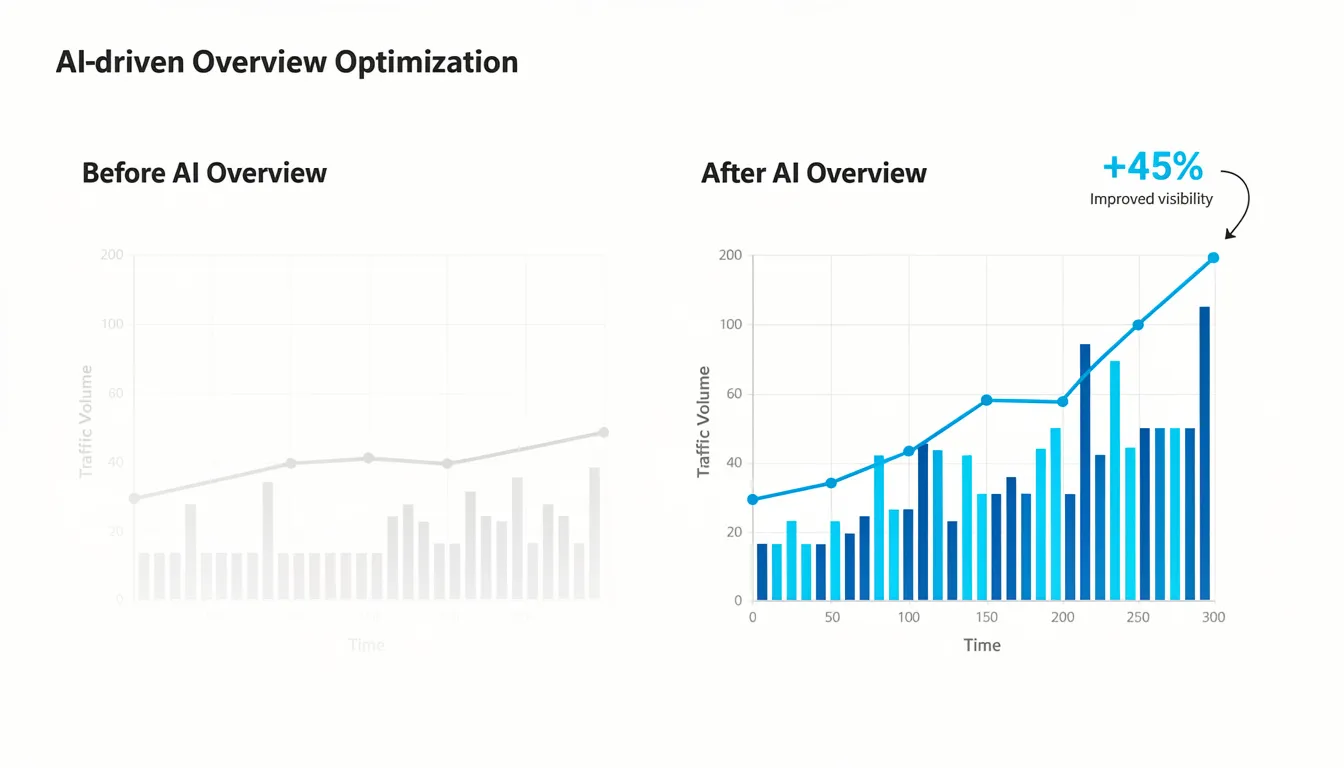
Case Study 1: Healthcare Authority Site Dominates Medical Query AI Overviews
A mid-sized healthcare content site focusing on preventive medicine implemented comprehensive AI overview optimization across their top-performing articles. The site had strong domain authority but limited visibility in AI-generated answers despite ranking well organically.
Optimization approach:
Results after 6 months:
The success factors included leveraging existing domain authority, focusing on high-stakes medical information where accuracy is paramount, and providing comprehensive coverage that addressed common follow-up questions within individual articles.
Case Study 2: B2B Software Company Captures Technical Query Market
A project management software company created an extensive knowledge base targeting technical implementation questions. Despite strong product-market fit, they struggled to appear in AI overviews for technical queries that their ideal customers were asking.
Strategic changes implemented:
Performance improvements:
The key success drivers were depth of technical coverage, practical applicability of content, and clear demonstration of implementation expertise that AI systems could confidently cite for technical guidance.
Industry-Specific Pattern Analysis:
Different sectors show distinct patterns in AI overview optimization success:
Industry
Most Effective Content Types
Primary Success Factors
Healthcare
Symptom guides, treatment comparisons
Medical authority, cited sources
Finance
Calculation guides, regulation explanations
Accuracy, current data
Technology
Implementation tutorials, comparison guides
Code examples, practical depth
Legal
Process explanations, requirement guides
Citation of legal sources
Education
Concept explanations, methodology guides
Clear structure, examples
Analysis of Common Content Patterns in AI Overview Featured Content:
Successful content consistently demonstrates several characteristics:
Measurable Impact Analysis:
Organizations implementing systematic AI overview optimization typically observe several measurable outcomes:
Technical Implementation Success Stories:
Several technical optimizations show consistent positive impact across case studies:
The most successful implementations treat AI overview optimization as part of a comprehensive content strategy rather than a separate tactical effort. Integration with existing SEO processes, content workflows, and technical infrastructure produces more sustainable and scalable results.
Organizations achieving the best results consistently invest in both technical infrastructure and content quality, recognizing that AI overview success requires excellence in multiple areas simultaneously.
The evolution of AI overviews represents just the beginning of a broader transformation in how search engines operate and how users discover information online. Understanding these trends helps shape long-term content and technical strategies.
Expected changes in Google’s AI overview algorithm will likely emphasize even greater accuracy requirements and source diversity. As the system matures, expect tighter integration between AI overviews and traditional search features, with more sophisticated evaluation of content credibility and user satisfaction.
Anticipated algorithm developments include:
Integration with voice search optimization strategies becomes increasingly important as AI overviews provide the foundation for spoken answers across smart devices and voice assistants. Content optimized for AI overviews naturally aligns with voice search requirements.
Voice search alignment factors:
Impact on traditional featured snippets and SERP features suggests a gradual evolution rather than complete replacement. AI overviews may absorb some featured snippet functionality while creating new opportunities for content visibility through synthesis and citation.
SERP feature evolution trends:
Preparing for multimodal AI overviews (text, images, video) requires content strategies that span multiple media types while maintaining coherent messaging and optimization approaches.

Multimodal optimization considerations:
Long-term content strategy for sustained AI overview presence must balance current optimization techniques with adaptability for future algorithm changes and user behavior evolution.
Strategic framework elements:
Industry implications and competitive dynamics will shift as AI overview optimization becomes more mainstream. Early adopters currently enjoy significant advantages, but these will diminish as optimization techniques become widely adopted.
Future competitive factors:
Preparing for AI-first search behavior requires understanding how user expectations and search patterns change when comprehensive answers are readily available at the top of search results.
User behavior adaptations:
The organizations most likely to succeed in this evolving landscape are those that view AI overview optimization as part of a broader commitment to content excellence, technical innovation, and user value creation. Rather than chasing specific algorithmic signals, the focus should be on building sustainable competitive advantages through superior content, technical infrastructure, and user experience.
Success in the AI overview era requires balancing optimization for current systems with flexibility for future developments, maintaining focus on fundamental principles of quality, accuracy, and user value while implementing specific technical and content strategies that align with AI system preferences.
AI overview optimization represents a fundamental shift in SEO strategy, requiring new approaches to content creation, technical implementation, and performance measurement. Success depends on understanding how AI systems evaluate and synthesize content while maintaining focus on user value and content quality.
The most effective strategies combine traditional SEO excellence with AI-specific optimizations: comprehensive topic coverage, clear question-and-answer structures, robust technical foundations, and systematic performance tracking. Organizations that implement these approaches early gain significant competitive advantages as AI overviews become more prevalent across search results.
Start optimizing your content for AI overviews today by conducting an audit of your existing content structure, implementing FAQ schema markup, and restructuring key pages around question-based formats. The future of search visibility increasingly depends on becoming a trusted source that AI systems confidently cite for user queries.
Your new AI assistant will handle monitoring, audits, and reports. Free up your team for strategy, not for manually digging through GA4 and GSC. Let us show you how to give your specialists 10+ hours back every week.
Read More
December 12, 2025
December 11, 2025
December 10, 2025
Just write your commands, and AI agents will do the work for you.