
December 12, 2025
Understanding the Google Core Update of December 2025: What It Means, Who It Affects, and How to Respond
December 11, 2025
Generative Engine Optimization (GEO): The Complete Guide to Ranking in AI Search
December 10, 2025

Author:
.png)
Consumer and business search used to be predictable. Google delivered a universal top-10 local SERP for everyone. The only variables were category relevance, citation links, and review count. That system was built for scale, not personalization.
Now, discovery is dictated by context. AI systems combine real-time surroundings, past interactions, query history, device environment, and behavioral fingerprints to personalize the results. Local search is no longer simply “nearest business wins.” It’s “best answer for this person in this moment wins.”
AI chat engines don’t rank URLs — they rank selections. Their core job is to narrow down the infinite pool of local vendors into a handful of personalized candidates, then confidently recommend one. These models infer relevance through multi-source embeddings built from proximity, context, behavioral demand cycles, social search signals, and review sentiment correlation.
This creates a new layer above both Maps and organic SERP: personalized local relevance surfaces inside AI answers.
Thesis: Local rankings are becoming “for-me rankings’’, clustered by personal intent rather than geography alone.
A local intent cluster is not just a group of keywords. It’s a structured set of consumer needs mapped to a location and evaluated as a single semantic entity by AI models.
Each cluster represents a combination of:
Unlike classic local SEO — where the goal was to rank high for city + service keywords — these clusters include personal qualifiers like:
near me, open now, cheap, for delivery, safest, for students, best service for my city, fastest provider in my city, best app available here.
This changes ranking logic. AI models build separate embeddings per cluster, even when the root query is the same. “Best pizza Berlin” and “Best pizza Berlin, open now, cheap delivery” are no longer slight variants — to AI, they are entirely different recommendation spaces with different relevance scores.
The key difference: search engines cluster by mechanics, AI clusters by personal need embeddings.
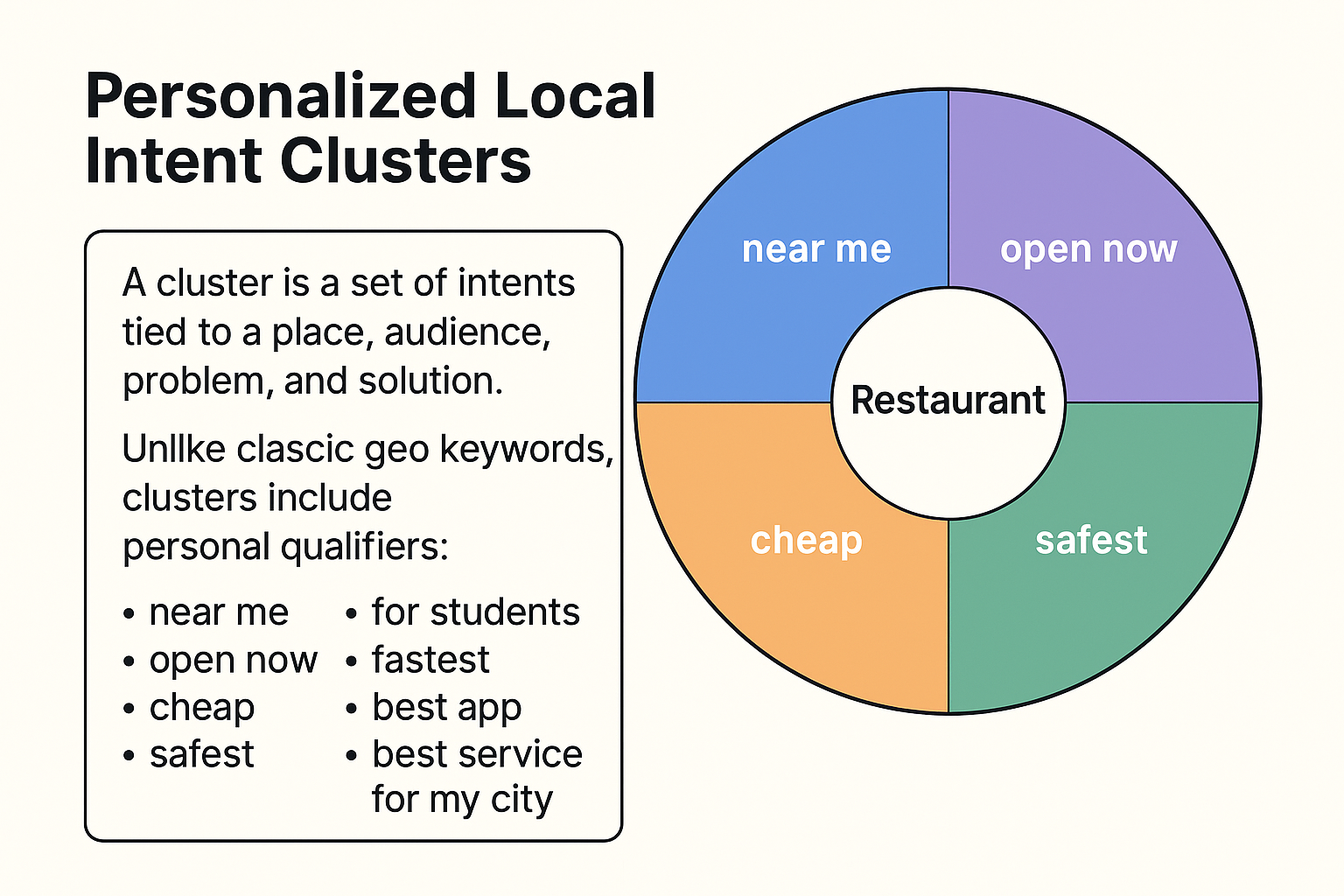
A Personalized Local Intent Cluster is not just a keyword group — it’s a decision blueprint with context.
Each cluster contains a set of related intents that combine place + audience + problem + solution into one searchable unit.
Unlike traditional local SEO based purely on geographic modifiers (city, district, region), personalized clusters embed human qualifiers that reflect real purchase or demand conditions.
These qualifiers often include:
The key difference:
Classic local SEO ranked pages by location. AI ranks content by personal intent clusters rooted in a location.
AI models generate separate embeddings for each cluster, even when the core query looks similar.
For example, the following queries exist in entirely different AI scoring universes:
To a human, these look related.
To AI, these are independent relevance clusters with distinct intent weights, trust scorers, and ranking paths.
For B2C and B2B brands targeting local visibility in 2025, understanding this difference is crucial — because every cluster becomes a unique ranking opportunity if built intentionally.
Local ranking in the AI era is scored through a multi-layered personalization engine. It uses five primary evaluation stages before recommending or citing a vendor inside AI search output.
This creates the local ranking equation of the AI era:
Local ranking = behavioral proof + contextual precision + intent chunk relevance + entity dominance across personalized local surfaces.
When B2B or B2C brands optimize for places alone, they compete for clicks.
When they optimize for personalized local intent clusters, they compete for recommendations.
And recommendations now define rankings.
Local SEO used to be predictable and location-dominant. Search engines ranked businesses based on geo signals and link validation, assuming that users in the same city had the same intent.
It worked because rankings were built for a one-SERP-for-all model.
The key difference:
Google ranked URLs. AI ranks decision confidence around entities using intent chunks.
We shifted from keyword matching → meaning matching → vendor recommendability scoring.
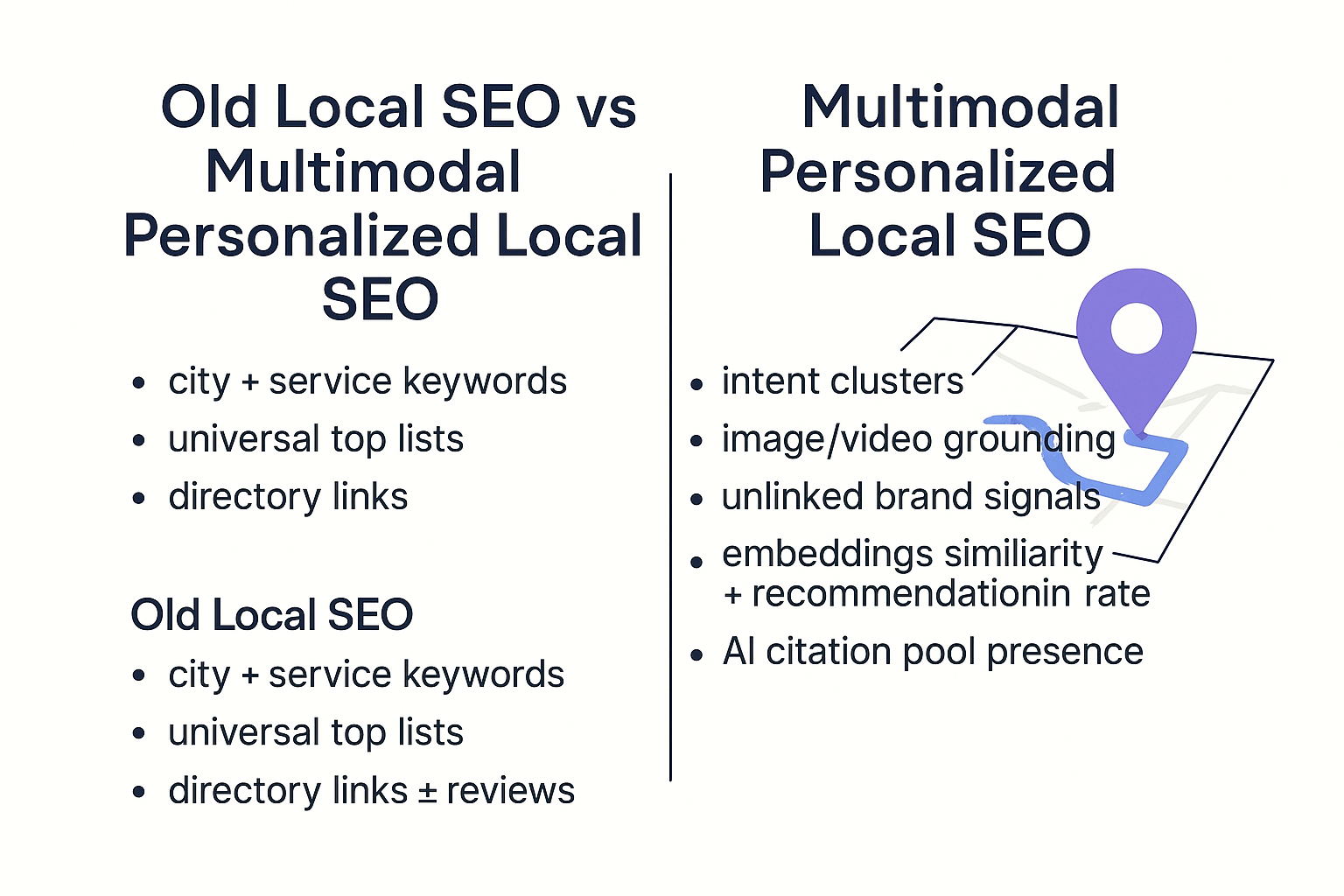
AI models no longer process local discovery as one geographic cluster.
They break search into independent intent clusters, each representing a personalized local demand scenario.
AI separates clusters as if they were different products, even when the service is the same but the intent wrapper changes.
Examples of cluster qualifiers AI interprets separately:
Each cluster defines ranking inclusion probability, not just ranking position.
When answer chunks, compliance proofs, reviews, and mentions repeatedly validate a vendor’s relevance inside a region-focused intent bubble, AI increases the brand’s confidence score, making it more likely to recommend — and recommendation == ranking.
In 2026, local search will no longer be built around universal geography signals alone. AI models are shifting toward context-first ranking systems, where location is just one layer inside a wider personalization engine. Instead of matching “city + service” keywords, search systems will match personal needs expressed in intent clusters — near me, open now, safe for my data, fastest delivery, best option for my situation, not just the best option in general.
AI will depend heavily on real-time context and behavioral validation signals. Time of day, device, movement patterns, past interactions, and even financial or safety preferences will contribute to “for-me rankings.” This means static map pack rankings and universal top lists will progressively lose ranking share to answers that are generated on demand for the individual.
The AI citation pool will also change in structure. Vendors and brands that fail to maintain entity consistency across web sources, product attributes, reviews, and local data hubs will gradually decay from recommendation eligibility. The system will not penalize them manually — they will simply stop being selected as confident data points for AI extraction. If the model cannot reconstruct a clean brand entity, the brand falls out of the trust graph, not the index, but the outcome for visibility is the same: less discovery, less citations, less conversions.
Local SEO will evolve into something bigger than landing pages or Google Business Profile rankings. The winners will build intent-cluster knowledge systems — interconnected content blocks enriched with images, diagrams, datasets, and facts that AI can turn into structured narratives. Websites will act as the databases, but the actual ranking will happen at the block level, deeply shaped by intent-fit probability and recommendation accuracy rather than link count or keyword repetition.
In 2026, Local SEO stops being a channel. It becomes a living, continuously refreshed intent graph owned by the brand that can provide the cleanest, clearest, most AI-aligned contextual truth for each consumer in each micro-region.
Your new AI assistant will handle monitoring, audits, and reports. Free up your team for strategy, not for manually digging through GA4 and GSC. Let us show you how to give your specialists 10+ hours back every week.
Read More
December 12, 2025
December 11, 2025
December 10, 2025
Just write your commands, and AI agents will do the work for you.